A Forum for Discussing and Analyzing Healthcare Issues

Digesting Medical Progress

By Michael D. Miller MD
September 1st, 2008

One of the challenges for improving the healthcare system is creating a vision for what is achievable in a timeframe of months or years.  The first step for creating such a realistic vision is to understand how progress has been made in the past.

A microcosm of such progress was described in a recent article in The Economist.  This article describes advances in our understanding of stomach ailments – one of my favorite areas of biomedical progress because in the last several decades dramatic changes have occurred in our basic knowledge about this area, and so many people can relate to stomach problems.

The most significant change occurred in 1982 when two Australian scientists disproved the dogma that because of its very acidic pH the stomach was sterile.  They showed that the H. pylori bacteria could live in the stomach and cause the stomach inflammation associated with an upset stomach.  Subsequent research showed that H. pylori could be the cause of ulcers and stomach cancer. Following those discoveries, medicines were developed to change the pH of the stomach to treat the stomach inflammation and eliminate the H. pylori.

H. Pylori

While lowering the acidity of the stomach with medicines would often improve symptoms, it also raised the question about what bacteria might be able to live in the stomach under less acidic conditions?  This question is more intriguing because it has been observed that when people taking medicines to lower their stomach’s acidity stopped taking these medicines, they have a resurgence in their symptoms.  This could be because their stomach had become accustomed to the less acidic conditions and then reacts to the renewed acidity; Or it could be because the bacteria that were living in the less acidic stomach are not happy with the greater acidity; Or perhaps the H. pylori that had been struggling in the less acidic stomach multiply very happily with the return of the acidic conditions.

H. pylori – Obesity and Asthma
The Economist article discusses some even more interesting ideas about the role of H. pylori in the stomach.  For example, they cite researchers who speculate that the elimination of H. pylori from the stomach may be linked to rising rates of obesity and cancer in the esophagus. These researchers at NYU School of Medicine also found that children who had not been infected with H. pylori were more likely to have asthma.  The article summarizes these observations with the speculation from NYU’s Dr. Blaser that perhaps H. pylori should be viewed not as a pathogen, but rather as a symbiotic organism “that is sometimes helpful and sometimes harmful.”

One of Dr. Blaser’s key observation is that H. pylori appears to not just be a passive resident of the stomach, but may actually regulate the stomach’s acid levels to keep the stomach’s pH in a range the bacteria prefer.  However, the substance that H. pylori secretes to get the stomach to produce less acid may be toxic to the stomach and result in ulcers and local cancers.  Thus, while eliminating the H. pylori would eliminate the toxic source of ulcers and cancers, it can also allow the stomach to produce too much acid – which can lead to cancer of the esophagus, as well as “acid reflux disease,” a.k.a. “heartburn.”

The H. pylori-obesity link is based upon the possibility that the bacteria modify the secretion of certain hormones effecting how people feel hungry, and the H. pylori-asthma link is based upon the effects the bacteria may have on children’s developing immune system.  (See The Economist article for more information about these areas.)

Conclusions
These findings lead to the conclusions that perhaps treating stomach ailments and preparing peoples’ stomachs for healthy lives should be based upon their genetic makeup, and seeding children with strains of H. pylori that don’t produce the toxins that can lead to ulcers and stomach cancer, could benefit them without doing harm in the long run.

Overall, this is a great example of how once more knowledge is obtained about a disease and the relevant human physiology, scalpel-like treatment and prevention strategies can be developed and implemented.  Of course, educating clinicians, patients, payers and others about these advancements – and why they are important – are also important challenges, because improving health care treatments and our healthcare system involves not just determining what should be done, but also how to actually accomplish those things.

Changing Life Sciences Communications Environment for 2009

By Michael D. Miller MD
August 25th, 2008

Cost containment is becoming an increasingly powerful force in shaping the environment for life sciences companies - as well as other parts of the healthcare system.  In addition, more sophisticated tools for analyzing and demonstrating the clinical and economic value of medical treatments are making it more challenging for life sciences companies to communicate the value of their new products to all types of audiences, including clinicians, payers, patients and regulators.

These new tools and the changing environment are requiring life sciences companies to think about developing more sophisticated messages to reach these audiences. I recently recorded a short 6 minute discussion about these topics with Jeff Sandman, CEO of Hyde Park Communications - where I am also a Senior Counselor.  Click on the icon-link below to listen to our discussion.

Podcast-MDMiller-JSandman-0808

And as always - if you have any comments on this topic - please feel free to share them.

Importing and Exporting Health Care

By Michael D. Miller MD
August 18th, 2008

The August 16th Economist had an interesting article (and commentary) about patients traveling to other countries for medical treatments, a.k.a. “medical tourism.”  The article focused on the US healthcare system, and mentioned other parts of healthcare that are being exported, (such as transcription of medical records, reading of imaging studies), and imported, (such as physicians and nurses).  But there are two aspects of this issue that the article didn’t touch upon – chronic care and pharmaceuticals:

Medical Tourism Doesn’t Work for Chronic Care
Patients are traveling from the US to other countries for expensive procedures like heart surgery and joint replacements.  While savings from this medical tourism can be significant on a per procedure basis, it may only make a small dent in overall healthcare spending – and only produce a dip in cost while not significantly changing the growth rate in health care costs.  But more importantly, such medical tourism doesn’t address the expanding problems of providing care for patients’ chronic conditions – which is a major driver of increasing healthcare costs.

Importing Medicines – Safety
Importing medicines from other countries into the US has been a controversy for more than 10 years.  The US Congress has repeatedly authorized the importation of medicines from other countries provided the Department of Health and Human Services certified their safety.  But the HHS (under both Democratic and Republican administrations) has not made such certification – and that was before the deaths earlier this year from contaminated heparin manufactured in China.

Importing Medicines – Politics
While the Obama and McCain campaigns have very different positions on health care reform, their statements on importing medicines are very similar in that both include provisions for importing medicines only if they are safe:

  • “Obama will allow Americans to buy their medicines from other developed countries if the drugs are safe and prices are lower outside the U.S.”
  • “John McCain will look to bring greater competition to our drug markets through safe re-importation of drugs”

Healthcare Jobs and Economic Growth
The world is clearly becoming flatter for healthcare goods and services, and this could be a worrisome trend for the US economy since healthcare products, delivery and research are significant drivers of US economic growth. After all, healthcare jobs – in both delivery and biomedical R&D – are high skilled, high wage jobs that depend upon an educated workforce and an economical comfortable society that can devote a significant portion of its income to healthcare.  If the US starts shipping more and more healthcare jobs (and money) overseas, this could result in a downward spiral as the loss of those jobs undermines the strength of the US healthcare system and the country’s economic growth.  However, it is uncertain how much the loss of that part of economy could be offset by potentially lower healthcare spending – a cost that some economists believe is inhibiting economic growth in the US and our global competitiveness

Questions and Answers About Pay-For-Performance (P4P)

By Michael D. Miller MD
August 14th, 2008

An article in the July/August Health Affairs about Massachusetts health plans implementing Pay-for-Performance (P4P) incentives for physicians raised more questions than it answered.

The study found that P4P programs from 5 private sector payers “wasn’t associated with greater improvement in quality” compared to the overall upward trend in the factors measured.  But the study didn’t address some overarching questions and basic realities about P4P, such as:

  • How the payers P4P incentives to the physician groups was actually translated into incentives for the individual physicians - or smaller groups of physicians inside the larger groups?
  • How the P4P incentives compared to the other financial incentives the physicians are facing?  For example, seeing more patients or doing more procedures could increase their income more than meeting the P4P standards. (The Health Affairs article states that P4P incentives for Massachusetts physician groups averaged 2.2% of their income.)
  • The quality measures used in the study were all performance based, rather than actual outcomes, e.g. cholesterol screening rates rather than patients’ actual cholesterol levels, HbA1C screening rates in diabetics rather than their actual HbA1C levels, or asthma medication use for children ages 5-17, rather than ER visits or hospitalizations for these same children.  What impact does that has on physicians’ behavior, and the value of changing their actions to meet these process standards?  Would physicians be more responsive to incentives tied to clinical outcomes?

Making Incentive Programs Successful:
While the study concluded that the P4P incentives program instituted in 2002 may not have produced dramatic changes in the HEDIS process measures, that does not mean  they were ineffective or that P4P is not a useful tool.

First, while collecting process measures data is easier, since clinical outcomes are what patients (and their physicians) should really care about, shouldn’t P4P incentives be based upon actual clinical outcomes? Process measures are easier to monitor by using billing data, but as the prevalence of quality electronic medical records systems grows, collecting and analyzing data about clinical outcomes will become much easier.  In addition, measuring a small set of any factors – process or outcome – presents the pitfall of driving physicians to focus on those diseases and measures to the exclusion of other important things.  For example, in the Health Affairs study, there are a number of preventive services in the process measures, but what about flu vaccinations, colonoscopies or smoking cessation?  This “managing what is being measured” behavior is why the number of factors used for P4P incentives should be as broad as possible.  (But this does not mean that they all have to be measured at every interval, or for every compensation period.)

Second, as any psychologist (or parent) will attest, the time between the actions and the reward (or penalty) is very important for changing behaviors. The Health Affairs article indicates that the bonuses are paid to the physicians groups annually.  Having the incentives paid annually, (or even quarterly), would be unlikely to provide adequate feedback to physicians to prompt them to change their behaviors.  An alternative blended methodology would be to provide physicians feedback on their actual performance against many of the possible measures on a weekly or bi-weekly basis, while making the P4P payments on a monthly or quarterly basis.

Third, many large companies structure their bonuses for their senior managers around a minimum of 20% of compensation.  If incentives for P4P programs only represent a small percentage of physicians’ income, then it would be unlikely to change their behaviors – particularly if they can make up for any lost income by increasing volume.  However, if physicians are being paid a fixed (capitated) amount per month to provide a certain set of services to a patient group – either primary or specialty care – then the volume part of the equation disappears, and P4P programs could be much more effective, even at a lower fraction of their potential income.

And lastly, and most simply, the insurers would not be spending time and money developing and implementing these programs if they didn’t think they provided some benefit – even if it is only financial - so they must be getting some benefits, or at least learning some things to make these programs beneficial in the future.

Conclusions:
18 years ago I wrote a book chapter that focused on structuring incentives for physicians.  Since then it has been hard to move payers and clinicians toward using more focused financial incentive systems.  But the P4P concepts are important, and to be successful they need to be implemented in a way that works for payers, physicians, and patients.  Unless these and other stakeholder groups buy-in to the purpose and practice of such incentives systems, they are unlikely to have the desired effects.  And the result will be more of the same – rising costs, variable quality, and limited access for many patients.

Republicans Give Up on Health Care

By Michael D. Miller MD
August 11th, 2008

A political insiders poll conducted by the National Journal (and published in their August 2nd issue) shows that Republicans are not counting on health care to help their party in the November elections.

Among the 7 choices to the question, “Which two issues will most help your party in November’s election?” none of the 42 Republican insiders picked health care.  Compared to that 0%, Energy was chosen by 90%, and National security by 31%

The poll results were also interesting for what the Democrats chose.  It appears that they are giving up on Immigration and National security as the issues that will help them in the November election – those two issues were picked by none of the Democrats.  Rather, Democratic insiders chose Economy (87%), Energy (39%), Iraq (37%)…. And of course Health care (21%)

So what does this mean for the actual election?  Are these political insiders too myopic with inside-the-beltway perspectives?  I find it hard to believe that Republic voters won’t care at all about health issues – particularly many of the conservative physicians who may be peeved about the President vetoing the bill to avert the Medicare 10.6% cut - which Congress later voted to overide.

Well it seems that the Democrats and the Republicans both have some validity in their positions:  According to Gallop’s June 15-19 issues poll, the Democrats do have a big edge on healthcare and the economy:

Gallop 2008 Election Issues Poll Obama v. McCain

And according to CNN’s issue tracker from June 4-5 polling, the most important issue for registered voters was:

  • Economy 42%
  • War in Iraq 24%
  • Health care 12%
  • Terrorism 11%
  • Immigration 8%

Taking all this together it looks like Democrats have the edge in the issues that are most important to the voters.  How this changes between now and November 4th as voters respond to new events and the campaigns’ messages will likely determine the election – assuming neither candidate makes major missteps.

Colon Cancer Insights – Vitamin D and Cannabis – “Good and Good for You”

By Michael D. Miller MD
August 7th, 2008

A couple of recent reports provide new insights into preventing and treating colon cancer.  These studies remind me of the scene in Woody Allen’s movie Sleeper, where he wakes up in the future to find out that all the things he thought were bad for you are really healthy.

The first study was in the Journal of Clinical Oncology which found that people who had higher levels of circulating Vitamin D and later developed colon cancer had a better survival rate than people with lower Vitamin D levels. An accompanying editorial points out that this could be because people who exercise more are outside for longer periods of time – which gives them more sun exposure leading to higher Vitamin D levels – and that more exercise itself might provide a better survival rate.  The editorial also notes that Vitamin D does not appear to promote the growth of cancers at higher concentrations like some other compounds which have been investigate for preventing cancer, such as folic acid.

The second article, (in the journal Cancer Research), describes how inactivating the cannabinoid receptors in human colon cancer cells (which had been implanted into mice) caused the cancer to grow faster.  And conversely, reactivating and stimulating these receptors slowed the growth of the cancer cells and led to their death.

These basic research studies are only starting points for changing how patients are actually treated, or advising people how to lower their colon cancer risks.  But like all good research, they can narrow the focus for future investigations.  In the case of Vitamin D, there is an ongoing study to see if providing Vitamin D supplements to people who have had precancerous colon polyps can prevent the development of more polyps and cancer.  And the cannabinoid receptor study may break new ground into treatments for colon cancer, just as more understanding of the hormone receptors in breast and prostate cancer led to new treatments for those malignancies.

Clearly, these are good scientific advancements, but I don’t think they will soon lead to doctors recommending a big glass of milk and “magic” brownies for all their patients – although more milk may becoming part of standard nutritional advice – particularly low-fat milk. [See previous posts about Vitamin D here and here.]

As the saying goes, “Good and Good for You.”

National Health Spending – Lots of Confusion

By Michael D. Miller MD
August 4th, 2008

I was at a party over the weekend with a number of clinical Fellows from a major academic medical center. They were all very nice, but I had a very strange conversation with a couple of the Fellows.

The conversation became strange when one of them asked me about what I thought was the biggest healthcare spending problem.  Rather than let me fully explain what I thought, they somehow quickly pronounced that pharmaceuticals were the largest cost in the US healthcare system, implying that this was the biggest spending problem.  The strange part of this conversation was that one of them had just taken a health policy class at the public health school affiliated with their Fellowship program.

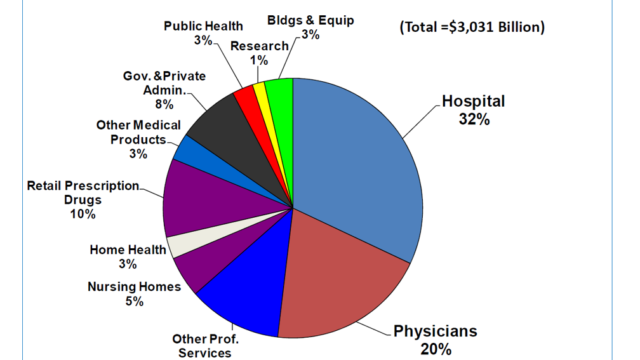
After “discussing” this with them for what seemed like 20 minutes, (but it was probably actually only 10 minutes), I convinced them that the reality was that hospitals and clinical services each represented about 30% of healthcare spending, and that pharmaceuticals were only about 10-11%.  (That 10-11% is only outpatient prescription drugs, but inpatient medicines don’t represent a major cost for hospitalizations.  And besides, payers don’t pay for inpatient pharmaceuticals as a separate cost, they pay hospitals a global fee based upon the patient’s diagnosis and severity of illness.)

Anyhow, after this conversation, the party’s host (who had been listening to our conversation from afar) came up and asked me if they were wrong – and I confirmed to him that they were – which is what he suspected.  (He’s a very smart computer scientist guy!)

So, after the party I decided to look up the actual numbers - since I can’t keep them exactly correct in my head - and according to the National Health Expenditure Data collected by the Center for Medicare and Medicaid Services,  the following pie charts display various categories for where health spending in the US went in 2006 (the latest year data is available), 1980, and the projections for 2012:

 2006 National Health Expenditures

[Note – In my conversation with the two clinical Fellows, my memory wasn’t far off. In 2006 spending was: Hospitals = 30.8%, All Professional Services = 31.4%, and Prescription Drugs = 10.3%]

 1980 National Health Expenditures

 National Health Expenditures 2012 Estimates

While this data is illuminating, I’m still bothered by these two young physicians insisting that prescription drugs are the biggest piece of health spending in the US – especially since one of them had just finished a 2.5 credit class called “Current Issues in Health Policy.”  And if these medical professionals have that magnitude of misunderstanding about our healthcare system’s finances, it’s no wonder that the average American, legislator, or media professional, is confused.  But at least it seems the computer scientists know what’s going on.

Literacy, Communications and Star Trek – Cores for Reforming Healthcare

By Michael D. Miller MD
July 30th, 2008

In talking to people about the problems with the US healthcare system, two fundamental truths have become apparent.

First, people really want the type of healthcare that is envisioned in science fiction such as Star Trek, where almost any ailment is treated with a single injection or pill, or a few waves of a healing wand. Unfortunately, medical science hasn’t accomplished that, except in a few instances – antibiotics for a bacterial infection, or perhaps relocating a dislocated finger or shoulder (and those still require weeks to heal and therapy to regain strength and mobility).

And second, the ongoing problem of healthcare literacy and communications may be getting worse as the complexity of medical treatments increases.  Literacy and communications problems impair good healthcare when patients don’t understand what their doctors are telling them, how to take their medicines, or what disease they have.  When this happens  patients have much greater difficulty properly taking care of themselves.  A few examples and data:

  • The American Academy of Family Physicians has a Literacy Toolkit which they promote with the twin facts that only 50% of “patients take medications as directed,” and “nearly 90 million American adults have difficulty understanding and using health information.”
  • A July 9th ABC news story reported about an Annals of Emergency Medicine article showing that 78% of Emergency Room patients had some misunderstanding of their doctor’s instructions, but only 20% realized that they didn’t fully understand the instructions.
  • More patients are misusing medicines in dangerous ways. The actor Heath Ledger’s accidental overdose was the most recent high profile example of this. And CNN reported Monday about an Archives of Internal Medicine study showing that deaths of this type have increased 700% in 20 years.

Star Trek directly addressed communications challenges in a Next Generation episode, (Darmok and Jilad at Tanagra), where the crew of the Enterprise encounters an alien race whose words are understandable, but none of it makes any sense. It turns out that the alien’s language is based upon metaphors, and since the Enterprise’s crew doesn’t understand the context for the metaphors – the mythology and stories behind the metaphors – communications is nearly impossible….. until of course Captain Picard figures it all out in 60 TV minutes.

Unfortunately clinicians and patients aren’t able to resolve communications challenges like TV characters. When clinicians use words and concepts that their patients don’t understand, patients can’t correctly follow their instructions, and end up relying on what they think they heard or understand.

A classic example of this is that many people think taking antibiotics makes them resistant to antibiotics.  While it is true that antibiotic resistance is an issue of concern, it is the bacteria that become resistant to the medicines – not the patients. But patients who believe that they will become resistant may not take the full dosages of their antibiotics, or for as long as the doctor has prescribed – inactions that can actually increase the rate of bacterial resistance and not adequately treat the patient’s infection – bad outcomes for both society and the individual.

This is just one example of how misunderstanding a disease or a treatment can produce adverse consequences. Similar misunderstandings about diseases like diabetes and high blood pressure also lead to inadequate treatments and poor outcomes. For example, many patients believe they can tell when their blood pressure is high – and only then do they take their medicine. But high blood pressure (or hypertension) is called the “silent killer” because people can’t feel high blood pressure – except sometimes when it is dangerously high.

Which brings us back to Star Trek. One of the great things about the one-dose cure is that the patient doesn’t have to understand their disease or remember to take their medicines for the treatment to be effective, so literacy and communications problems are less of an issue for quality of care.

Lessons for Healthcare Reform
The lessons here for health reform are twofold: First, producing one-shot cures will require a lot more research and development – which needs to occur at the same time as we are improving the healthcare delivery system. And second, a fundamental area for improving healthcare delivery is communications and literacy. If patients don’t understand their disease, how to take their medicines, or modify their lifestyle, etc., then that is not their fault – that is the fault of the healthcare delivery system, and we should be able to find ways to fix it because this is not a new problem.

Financial Returns from E-Prescribing – Saving Medicare $2.1 billion

By Michael D. Miller MD
July 23rd, 2008

The leadership of HHS had a tele-conference on Monday to highlight the new Medicare incentives for physicians to adopt e-prescribing systems.  What the Washington Post and Kaiser Family Foundation reported about this press briefing that wasn’t in the HHS press release was that the Acting Administrator of CMS said that the per physician cost of e-prescribing systems is about $3,000 up front, and then $80-400/month for operation and maintenance.

These numbers caught my eye, because with the incentives in the Medicare bill, the break-even point for physicians is as follows:

First, let’s assume that the per month cost is $240 (the mid-point between $80 and $400), or $2,800 per year. Since the Medicare incentives for e-prescribing are a net 2% of Medicare reimbursements, that means to break-even the physician has to have $144,000/year in Medicare reimbursements – just for the operation and maintenance costs.  Additionally if the up front costs are spread over two years ($1,500/year), that raises the break-even point another $75,000, to $219,000/year.

For some clinicians, this amount of revenues from Medicare might be low, and therefore, it would make sense to get an e-prescribing system. However, if the doctor only sees a minority of Medicare patients, then the incentives could be a penalty.  Which is exactly what Congress expects the financial effects of the e-prescribing incentives to be. According to the Congressional Budget Office, “CBO estimates that the net budgetary effect of the electronic prescribing provision will be to reduce Medicare spending by $0.2 billion over the 2008-2013 period and $2.1 billion over the 2008-2018 period.”

Of course, if other insurers were to match (or exceed) Medicare’s incentive payments for having e-prescribing systems, then obviously the break-even point for physicians would come down, since the calculations wouldn’t balance solely on Medicare revenues.  However, I’m not aware that other insurers are rushing to provide financial incentives for physicians to use e-prescribing systems.

Additional Points
There are additional important points about e-prescribing that need to be made.  First, e-prescribing can have additional costs for physicians’ offices in the form of training time and lost productivity, and unlike electronic medical records, e-prescribing itself is unlikely to improve the office’s billing accuracy and revenues.  Second, e-prescribing can certainly provide clinical benefits by reducing medical errors with better communications about individual prescriptions.  I wrote about these issues a couple of weeks ago (see “Challenges to Making E-Prescribing Increase Efficiency and Improve Quality”), but want to reinforce one point here: Going from paper to computer communications can also introduce new opportunities for medical errors – particularly if people rely on the computer generated information while they might question the legibility or accuracy of a hand-written prescription. That is, technology is great, but its appropriate role needs to be understood by the users, who also have to use it correctly for it to provide real value.

New Health Posting in Iraq

By Michael D. Miller MD
July 22nd, 2008

I couldn’t resist witting something about this when I saw today’s press release from HHS which announced that Terry Cline, Ph.D., the administrator of HHS’ Substance Abuse and Mental Health Services Administration is leaving that post, and starting August 31st he will be the HHS Health Attaché and representative at the U.S. Embassy in Baghdad, Iraq.

On the serious side, I’m sure he will do good things to help improve the healthcare system in Iraq.  But on the less serious side, someone (maybe Jon Stewart?), needs to ask how did this happen?  How bad did he step on someone’s toes to get moved from Rockville, MD to Bagdad? Or was he just doing intensive and personal research into abusing substances, which led him to believe that Bagdad would be a nice place to be for a while?

While I certainly hope that Dr. Cline has a safe and productive time in Iraq…. but while he’s over there, given his expertise in substance abuse, maybe he can get over to Afghanistan too, since I understand they have a bit of an issue with poppies and heroin.